


OAMI Explained: How GM's Automation Index Meets the Cobot Market, and Where Your Plant Should Sta
OAMI Explained: How GM's Automation Index Meets the Cobot Market, and Where Your Plant Should Start
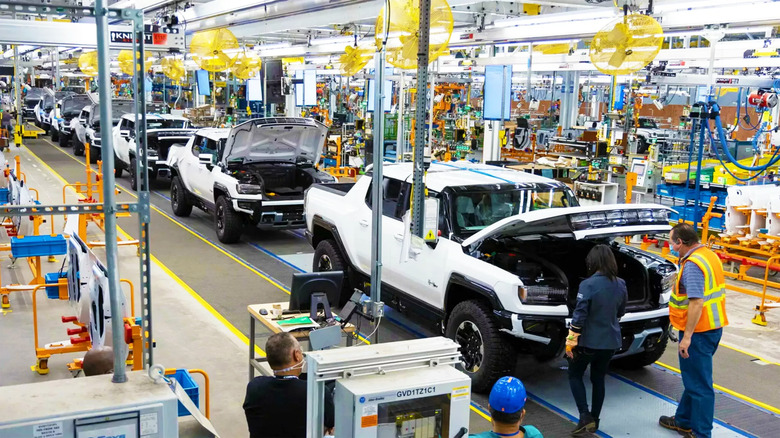
OEMs are raising the bar. Cobots are the most practical first step.
GM has asked its suppliers to score their own automation on a five-level scale, and 4.5 is reportedly the target. In the first half of 2026, North American companies ordered 2,774 cobots: 15.4% of all robot units, but only 9.8% of order value. For component manufacturers, a cobot cell may be the lowest-friction way to answer the bar. But in our view, a cobot on its own won't move your score. A cobot inside a connected, measured process will.
What's inside:
The bar: OAMI, GM's five-level automation index.
The market: What A3's first-half 2026 robot data shows.
The catch: What OAMI is, and isn't, asking of suppliers.
The proof: How GM, Stellantis and Ford use cobots and automation today.
The case: A UR10 wheel deburring cell that paid back in 1.5 years.
The move: Where to start on your floor.
What Is OAMI?
The Overall Automation Maturity Index (OAMI) is GM's framework for measuring how automated its suppliers' plants are. GM began sending suppliers a survey in March. Suppliers audit their own operations against GM's criteria, which cover the chain from raw material purchasing through production and delivery. In some cases, GM audits supplier plants directly. (AutoGuide, GM Authority)
People familiar with the matter told Crain's Detroit that GM is targeting 4.5 out of 5. GM has also posted a role to lead supplier OAMI assessments and set milestones toward 4.5 or higher.
The tension OAMI creates
GM says there is no industry standard for measuring automation across suppliers, so the survey works as a shared benchmark. Its spokesperson called the metrics “goals (not requirements).” Even so, suppliers worry about the cost of major upgrades, how those investments will be funded, and how any financial gains would be divided with GM. Some believe that falling short could affect future business. (Carscoops)
Suppliers are being asked to automate before they know who pays for it. That is the gap the next sections try to close.
The five OAMI levels
Manual operations
Basic mechanization
Semiautomation
Integrated automation
Smart factory with adaptive automation
The market behind it: A3's first-half 2026 data
Orders: 17,995 robots worth about $1.166B. Units rose 2.0% and value rose 6.6% over H1 2025.
Q2 record: $622M in Q2 order value, the highest second quarter in A3's series, which began in 2005.
Spending is moving down the supply chain: Automotive OEM orders fell 25.4% to 4,263 units. Automotive Component orders rose 23.8% to 3,866 units ($221.9M).
Cobots: 2,774 units and $113.9M. That is 15.4% of units and 9.8% of order value.
Per-unit order value (our calculation from A3 data): about $41K for cobots, against about $69K for all other robots.
Cobot share by industry: 43.7% of units in Life Sciences, 36.5% in Semi & Electronics, 21.6% in All Other Industries, 15.1% in Metals and 14.6% in Food & Consumer Goods.
Where the volume is: Handling and machine tending made up 66% of units ordered. Welding and soldering made up 20%.
In practice, this means automation budgets are landing in the supplier tier OAMI is grading, and cobots are a growing part of the mix.
The Path: 4 Steps From First Cell to Connected Plant
This is Bigwave's recommended approach, not a GM process.
Find the step where people strain, wait or repeat.
Add a cobot cell inside the existing process, with no layout change.
Capture cycle time, quality and status data from that cell.
Connect the cell to a plant-wide data layer, so results can be shown in an audit.
Our read: For most suppliers, the first cobot is not the finish line. It is the cheapest way to start generating the data and the repeatable process an automation audit will ask about.
The fine print
GM describes OAMI metrics as goals, not requirements, and has reportedly set no deadlines for suppliers. The 4.5 target comes from industry reporting, not a published GM standard.
A3 figures are based on data supplied by member companies and cover sales by North American robot suppliers to companies in North America.
Cobot share varies by quarter. In Q2 alone, 1,137 cobots were ordered, or 12.7% of units and 7.1% of order value, below the first-half average.
Per-unit values are order value divided by units. A3's order value includes the value added to the total robot system, so it is not a robot list price.
Quick answers
Is a 4.5 OAMI score mandatory? GM calls the metrics goals, not requirements. Some suppliers still expect it to influence sourcing.
Will cobots alone get my plant to 4.5? In our view, no. The index covers the chain from raw material purchasing to delivery. Cobots are a practical first step, but connected data and repeatable processes matter as much as the robot.
Why start with cobots? They average a lower order value per unit, they can be added inside an existing process, and the case study below paid back in 1.5 years.
What about jobs and safety? At GM's Factory Zero, the union has filed grievances and raised safety concerns about cobots. GM says the rollout improves safety, ergonomics and flexibility. Treat deployment as a people decision, not only a technical one.
Cobots on the U.S. Auto Line: 3 Plants Setting the Standard
A caged robot proves you can automate. A cobot proves you can automate around people. Three U.S. automakers show how that looks in practice.
1. Cobots at scale: GM Factory Zero (Detroit-Hamtramck) GM has installed more than 50 Fanuc collaborative robots at the plant, which builds electric trucks and SUVs. They handle repetitive assembly tasks such as attaching body panels. GM says the rollout is meant to improve safety, ergonomics and flexibility, and that the plant's layoffs are temporary and unrelated to the cobots. The union has filed grievances and raised safety concerns. (Read: Robots Cause a Ruckus in the Motor City (Assembly) | Read: General Motors lays off 1,000 workers in Detroit, adds 50 robots (NewsNation))
2. Cobots as logistics: Stellantis Stellantis uses cobots in its North American plants to deliver parts to the assembly line and support high-cycle-time operations. (Read: Automakers and workers face existential fight over robots, future (Bloomberg, via Spokesman-Review))
3. Ergonomics by design: Ford Louisville Assembly Plant Ford is investing $2 billion in the plant, which replaces one long final line with three parallel sub-assembly lines using robots and AI features. Ford says the layout cuts the need to reach over a fender by 84% and lets it build 15% faster than its current Louisville products. This example is about automation designed around operators, not cobots specifically. (Read: Ford Fathom production (Carscoops) | Read: Ford Fathom on Track: Universal EV Production System Comes to Life at LAP (Ford))
The shop-floor takeaway: In all three plants, automation starts where people strain, wait or repeat. Every manual handoff is a delay, a defect risk, and a line in the audit report.
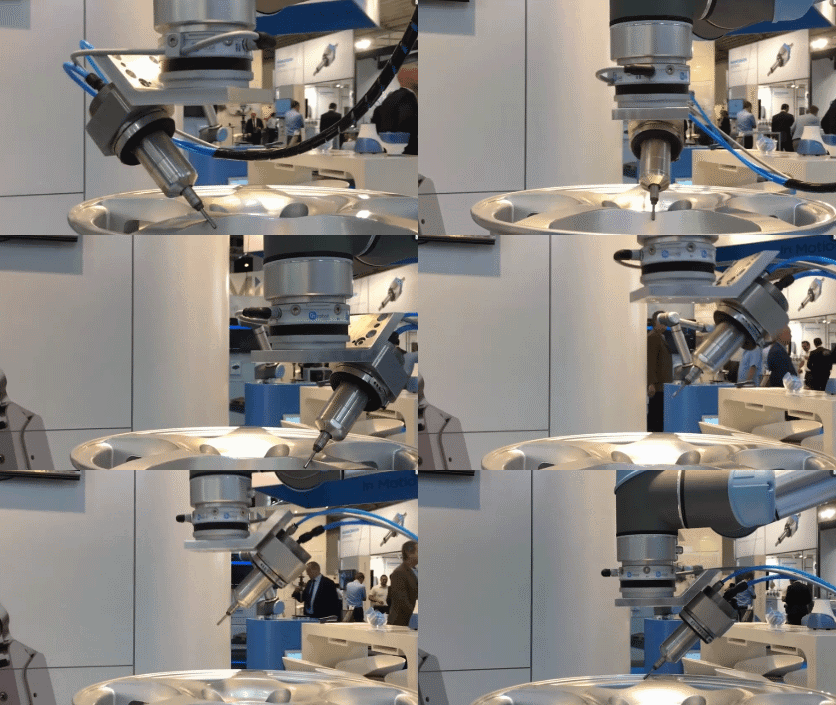
Case Study: UR10 + Force Sensing. 1.5-Year Payback on Wheel Deburring.
Most suppliers won't start with a full line rebuild. They start with one process where quality and labor strain collide. Automotive wheel deburring is a clear example.
Automotive Wheel Deburring with UR10 and OnRobot HEX Force/Torque Sensor
The Challenge: Deburring the edge of an automotive wheel is repetitive, physically demanding work. Operator strain and inconsistent quality lead to rework.
The Solution: One compact cobot cell, added to the existing process with no layout change:
Universal Robots UR10: 6-axis articulated robot with a 10 kg payload, 1,300 mm horizontal reach, 0.1 mm repeatability and IP54 protection.
OnRobot HEX-E force/torque sensor: keeps deburring uniform and precise while the tool follows the wheel's curved 3D surface.
Deburring tool and automotive wheel fixture jig: a three-step workflow of part input, 3D deburring operation and task complete.
Key Results:
1.5-year ROI
Operator musculoskeletal disorders prevented, improving labor conditions
Consistent deburring quality, with rework time significantly reduced
Higher productivity through minimized downtime and continuous operation
The lesson: A cobot cell won't take a plant to OAMI 4.5 on its own. It is the fastest first step: a compact setup, quick payback and a clean place to start capturing cycle-time and quality data. Start with the process that strains people and quality, then connect it.
Future-Proof Your Shop Floor with Bigwave Robotics
The deburring cell above was engineered by Bigwave Robotics. Whether your plant is answering an OEM automation survey or retooling lines for upcoming programs, isolated machines can no longer carry a sourcing audit. Bigwave is brand-agnostic: we pair field-proven robots from leading suppliers with our SOLlink and Data Studio platforms, so suppliers can start with one cell, connect it to real-time data and build toward OEM-level automation maturity.
Not sure where your plant stands? Bring your layouts, cycle times and output targets. Our engineers will help you find the first process worth automating.
👉 Stay Updated on Industry Trends [Join our LinkedIn Newsletter]
OAMI and GM's Supplier Program
Read: GM Wants Suppliers To Think About Replacing People With Robots (AutoGuide)
Read: GM Implementing Plant Automation Standards for Suppliers (GM Authority)
Cobots on the U.S. Auto Line
Robot Market Data
Read: A3, North American Robot Orders Increase in Q2 2026 as First-Half Order Value Rises 6.6% (July 29, 2026)