


GM Replaces Over 1,000 Workers with 50 Robots in Detroit: Is Your Plant OAMI-Ready?
GM Replaces Over 1,000 Workers with 50 Robots in Detroit: Is Your Plant OAMI-Ready?

According to recent automotive industry reports, General Motors has accelerated internal plant automation while introducing a decisive new metric to its global supplier evaluation process: the Overall Automation Maturity Index (OAMI). Following the restructuring of over 1,000 production workers at its Detroit-Hamtramck 'Factory Zero' facility, GM swiftly deployed more than 50 collaborative robots directly onto active EV assembly lines. Now, this aggressive automation push is extending across GM's Tier-1 and Tier-2 supply chain. Evaluated on a 5-level scale, GM has established a stringent target benchmark of 4.5 for component suppliers.
Just as the BIQS (Built-In Quality Supplier) standards revolutionized automotive manufacturing quality in the 1990s, OAMI is transforming connected automation readiness into a measured, benchmarked, and sourced-against requirement for winning future vehicle platform awards: Hit 4.5 or risk losing your next RFQ.
The OAMI Mandate: Why OEM Labor Shifts Demand a New Automation Standard
The rollout of OAMI reflects a major structural shift across the North American automotive ecosystem. As industry researchers observe, the labor time required to build a single vehicle has dropped by 50% to 70% since the 1980s through sustained automation. Today, that imperative is driven by intense global cost pressures and severe domestic labor shortages:
From Factory Zero to the Supplier Floor: GM's internal shift toward robotics is no longer an isolated operational choice—it is a direct compliance blueprint for suppliers. Component makers are evaluated on their ability to match OEM pace, quality, and cycle times.
Connected Ecosystems Over Isolated Machines: OAMI penalizes standalone mechanization. Level 4.5 compliance mandates connected manufacturing—where equipment, machine vision, PLC controllers, and shop floor operators communicate within a single, unified real-time data stream.
Bridging the Global Competitiveness Gap: Global manufacturers, particularly in Asia, operate with highly automated, low-overhead facilities. To maintain competitive cost structures amidst domestic recruitment bottlenecks, OEMs require supplier plants capable of high-throughput production with zero defect rates.
Suppliers relying on disconnected, manual, or slow-to-integrate line setups face severe audit penalties that could disqualify them from upcoming vehicle platform sourcing.
👉 [ Check Your OAMI Readiness ]
Understanding the OAMI Tiers: Why Standalone Robots Won't Pass Your Audit
GM's Overall Automation Maturity Index evaluates plant operations across five structured tiers:
Level 1 (Manual Operations): Heavy reliance on manual labor, paper records, and unmonitored human assembly tasks.
Level 2 (Basic Mechanization): Use of standalone power tools or fixed mechanical fixtures with no digital connectivity.
Level 3 (Semi-Automation): Deployment of isolated robots or CNC cells operating in data silos without plant-wide tracking.
Level 4 (Integrated Automation): Plant-wide synchronization where PLC signals, machine health, and cycle times communicate across a unified data layer.
Level 5 (Smart Factory Adaptive): Fully autonomous, AI-driven operations featuring real-time predictive diagnostics and adaptive line orchestration.
Many component suppliers make the costly mistake of assuming that purchasing additional standalone robots will automatically elevate their audit score. However, moving from Level 3 semi-automation to the required 4.5 benchmark demands bridging the operational gap between isolated hardware and plant-wide data orchestration.
Leading suppliers are replacing siloed machinery with standardized, pre-engineered modular robotic cells that integrate real-time operational layers before formal OEM audits arrive.
High Automation Maturity in Action: EV SUV Console Assembly Automation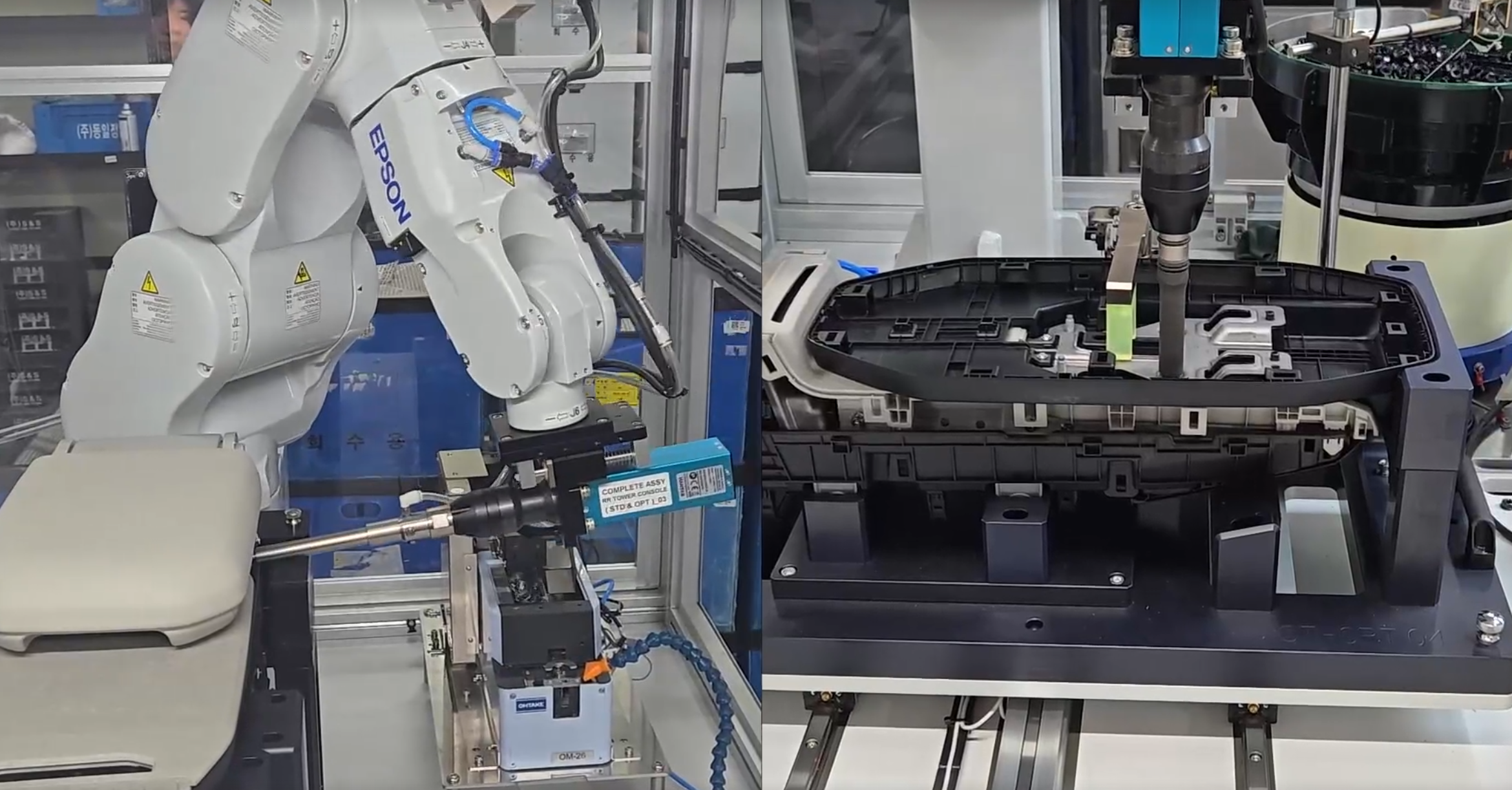
Elevating your plant's automation maturity rating to 4.5+ does not require a massive in-house robotics team or multi-year integration delays.
Consider a recent project executed by Bigwave Robotics: an Automated Electric Vehicle SUV Console Assembly Line for a major Tier-1 automotive supplier—a textbook demonstration of high automation maturity achieved through connected modular infrastructure.
The Challenge
The supplier faced high worker turnover, severe floor space constraints, and complex multi-option assembly requirements for a newly launched electric SUV console. Their legacy line relied on manual assembly requiring 40 to 60 workers per shift, resulting in inconsistent cycle times, human error risks, and persistent recruitment bottlenecks.
The Solution: Connected Modular Cells & Real-Time Orchestration
Bigwave Robotics engineered an automated assembly architecture combining high-precision SCARA and 6-axis articulated robots, unified by the SOLlink Industrial monitoring platform:
Flow-Line & Modular Flexibility: The assembly process was engineered into three coordinated cells—a conveyor-based flow line for large parts (wireless chargers, cup holders), a standalone unit for the console main body, and a high-density modular cell utilizing multi-joint articulated robots for simultaneous vertical and lateral screw fastening.
OAMI Alignment 1: Connected Data & Traceability via LOT Synchronization: Barcode scanners at each station integrate directly with a centralized LOT tracking system. As parts progress through the line, assembly parameters are recorded to eliminate mis-assembly defects and guarantee 100% component traceability.
OAMI Alignment 2: Real-Time Operational Intelligence via SOLlink: The entire cell is monitored on a unified SOLlink dashboard. Plant managers track robot workloads, cycle times, and machine health in real time, receiving automated issue alerts for immediate remote diagnostics and zero-defect continuity.
OAMI Alignment 3: Spatial Efficiency & Manpower Optimization: The compact modular cell tripled production capacity—enabling the assembly of 3 distinct product variants within the exact footprint previously required for 1—while reducing line personnel from 40–60 workers down to under 30.
Key Results
Manpower Reduction: Cut line labor dependency by over 40% while stabilizing daily output.
Zero-Defect Quality: Achieved 100% part traceability and zero mis-assembly via barcode-linked LOT control.
Rapid Payback: Delivered a full investment payback within 2.0 to 2.4 years.
Bridge the OAMI Gap with Bigwave Robotics
Achieving Level 4.5 automation maturity does not have to mean multi-million-dollar custom engineering overhead or multi-year deployment delays.
As your rapid automation partner, Bigwave Robotics eliminates the risk, friction, and delays of conventional integration. By pairing pre-engineered modular robotic cells with our SOLlink Industrial real-time monitoring platform, we help automotive component manufacturers modernize their shop floors, achieve OEM compliance, and secure upcoming program awards.
👉 [ Consult an OEM Compliance Specialist ]
Want to explore the original reporting on GM's automation push?
Read the full report on GM's Factory Zero cobot deployment and manufacturing automation strategy.